The organ and the music
The Schuke organ and the pieces it suits
What to know about the Memorial Church's Schuke organ, and a short listening guide to organ and string pieces that often appear on programmes like this.
Reserve your seat for the concert ↗Quick answer
The Memorial Church's organ was built by the Berlin firm Karl Schuke in the early 1960s and counts among the largest in the city. It stands on a gallery opposite the entrance, and it is played at services, vespers and concerts. Organ toccatas by Bach and Widor suit it well.
A new organ for a new room
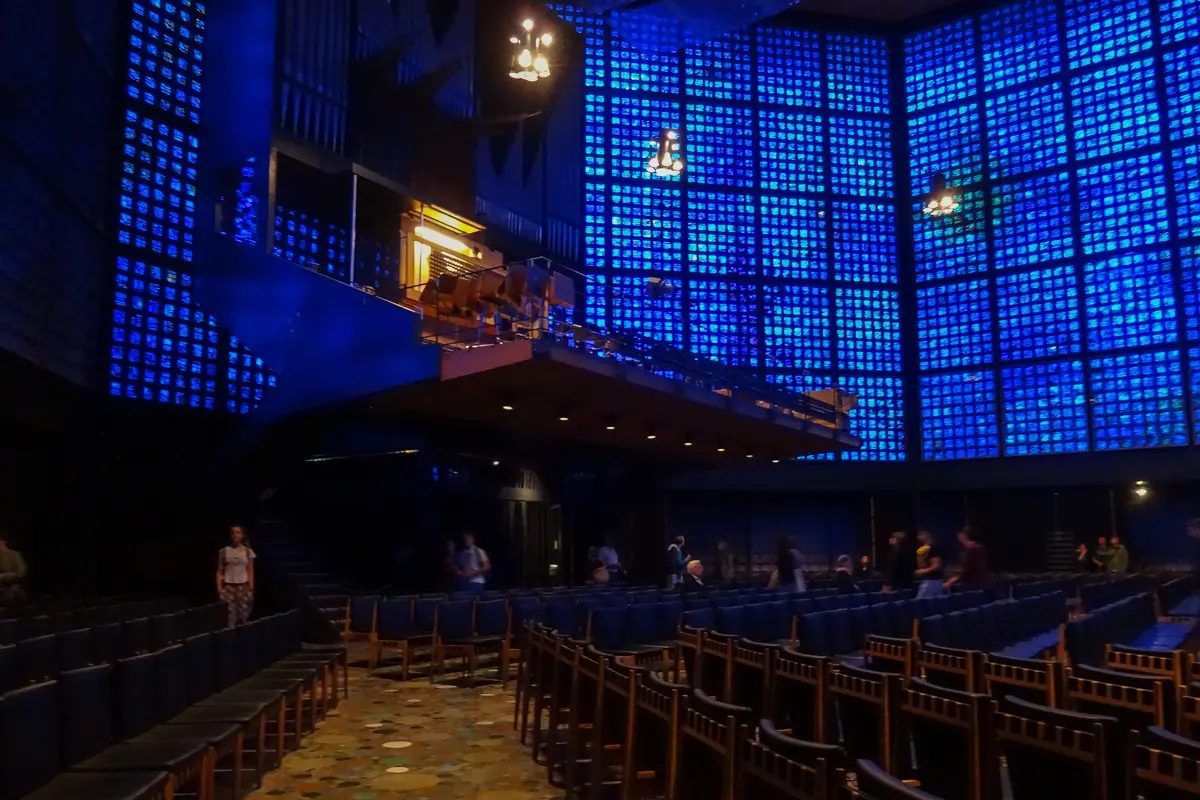
The organ was built in 1962 and 1963 by the Berlin organ workshop Karl Schuke, and the church counts it among the firm's most important works. Eiermann took a close interest in its design. The result is a case clearly divided by sections of the instrument, which gives a clear view of its structure in a small space, and a console that carries his hand too.
How big it is
The church describes nearly 6,000 pipes in 63 registers, while other sources give a figure nearer 5,000, so it is safest to say several thousand. It has four manuals and a pedal, a mechanical key action and an electric stop action with a combination system that has been updated several times. The church's specification was drawn up by Siegfried Reda, a leading church musician of his day, who favoured a colourful, overtone-rich sound.
A busy instrument
The church calls it probably one of the most played organs of its kind. It is heard daily at devotions and services, at organ vespers and at concerts, and guest soloists from Germany and abroad value both its range of sounds and its precise playing. Plexiglas panels were installed over the gallery to improve the acoustics. Visiting organists give recitals on it in the summer series, which the church has run with free entry and a suggested donation.
Listening to a toccata
A toccata is a showpiece, written to let the player's hands run quickly over the keys. Bach's Toccata and Fugue in D minor, BWV 565, opens with a toccata and ends in a fugue and coda, in the style of the north German organ school. It is one of the most recognised organ works, though a minority of scholars has doubted that Bach wrote it. In a tall glazed room the opening statements carry a long way.
Widor's toccata
Charles-Marie Widor wrote his Organ Symphony No. 5 in 1878 and 1879, while he was organist at Saint-Sulpice in Paris, and he gave the first public performance in October 1879. Its last movement is a toccata, one of the best known and most often recorded organ pieces. It became famous beyond concert halls when it replaced Mendelssohn's Wedding March at the 1960 marriage of Princess Margaret and Antony Armstrong-Jones, and many listeners know it without knowing the title.
Strings and voice
Not every piece uses the organ. Vivaldi's Four Seasons are violin concertos published in 1725, and Pachelbel's Canon was first written for three violins and continuo. Schubert's Ave Maria began life as a song for voice and piano. A programme can therefore move between organ pieces and string or vocal works without leaving the room, which is the format of a church concert like this one.
What to listen for
Listen to how the sound behaves in an octagon. The room is tall and its walls are glass and concrete, and the church had acoustic panels added over the organ gallery to improve the sound. Notice how a loud passage and a quiet one feel in the same space. Soft pieces such as the Lacrimosa from Mozart's Requiem, which Mozart left unfinished when he died in 1791, suit a space like this. Settle in and let the first minute pass before you judge the sound, since the ear needs a moment to adjust to a room of this size.
Sources